The AI Proof Gap: Why 78% of Enterprises Will Fail an AI Governance Audit (and How to Close It Before August 2)
4/30/20263 min read
The hardest question your board can ask you in the next ninety five days is also the simplest. If a regulator showed up tomorrow, could you prove your AI is governed? Not "policy on paper" governed. Logs, inventory, conformity records, fundamental rights impact assessments. The kind of governance you can put in a binder.
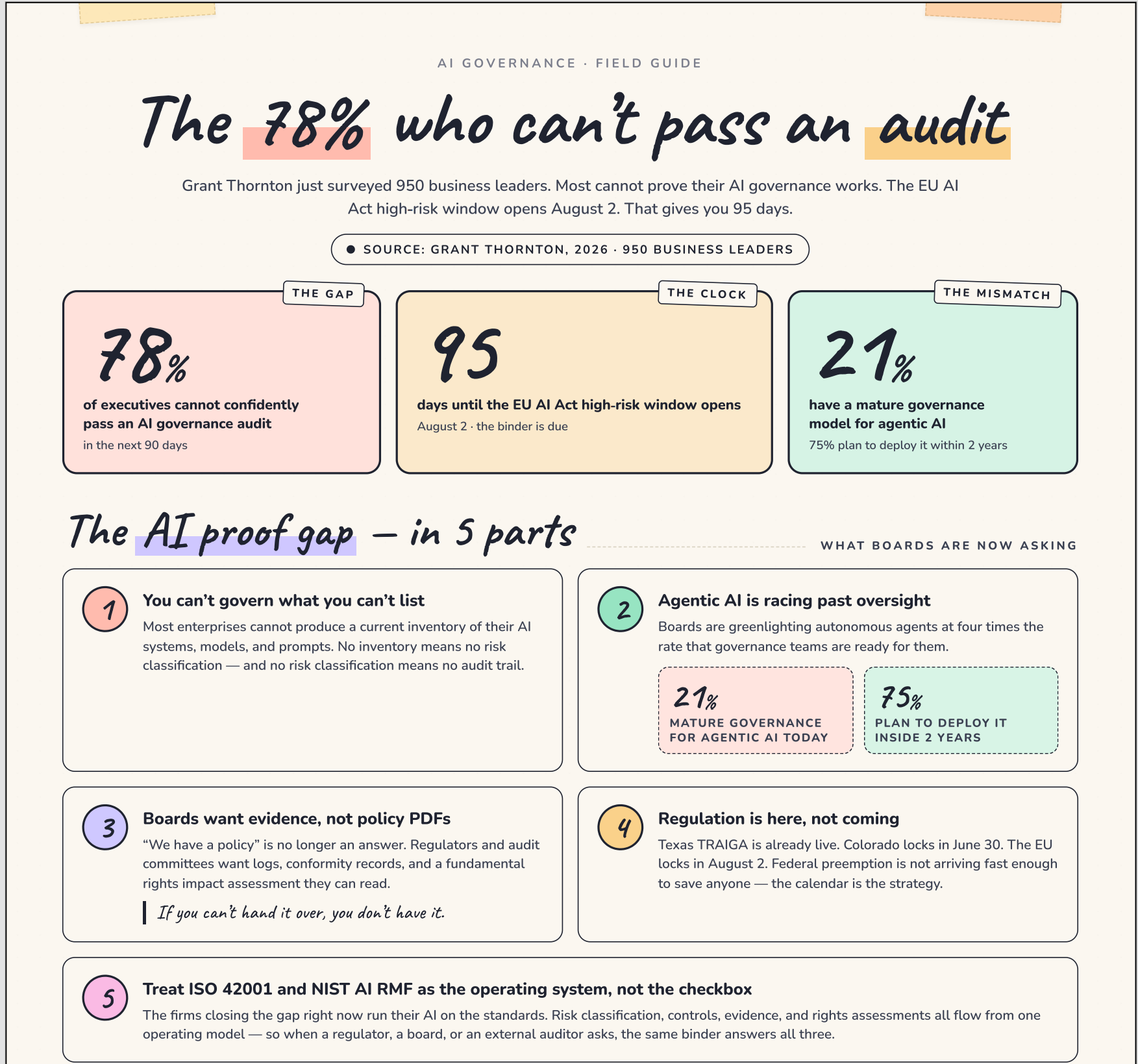
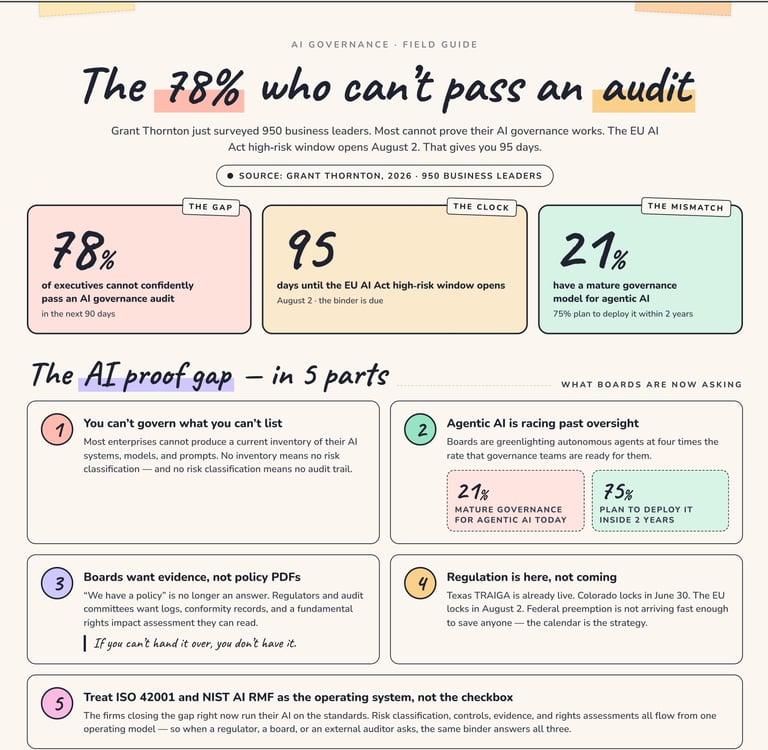
According to Grant Thornton's 2026 AI Impact Survey, 78 percent of executives lack strong confidence that their organization could pass an independent AI governance audit within 90 days. The gap between AI ambition and AI proof is the single biggest enterprise risk we are tracking right now. We call it the AI Proof Gap.
And the clock is loud. The EU AI Act's high risk obligations apply on August 2, 2026. Colorado's AI Act locks in June 30. Texas TRAIGA is already enforceable. Twenty five new state AI laws have passed in 2026, with another twenty seven through both chambers. Federal preemption is being debated, but no CTO or CCO can plan around a debate.
"Boards are no longer satisfied by a policy document. They want evidence. If you cannot produce it in ninety days, your audit fails."
What "the AI Proof Gap" actually means
An AI governance program built only on documents is not a governance program. It is a brochure. The AESIA guidance package out of Spain (sixteen documents released this month) makes the new bar very explicit. Regulators will ask for AI system inventories, risk classifications, technical documentation against Articles 9 through 15, conformity assessments, post market monitoring records, and human oversight evidence. Most enterprises cannot produce any of these on demand. More than half cannot even produce a current AI inventory.
This is why the Grant Thornton finding lands so hard. The 78 percent number is not "we are not ready to start." It is "we have started and we still cannot prove it."
Why most existing AI policies fail under stress
Three reasons. First, the policies were drafted before agentic AI changed the surface area. Seventy five percent of organizations plan to deploy agents in two years, but only 21 percent have a mature governance model for them. Second, policies live in legal's drive while AI lives in engineering's git repos. The two never reconcile. Third, almost no enterprise has built the data plumbing that produces evidence as a byproduct of normal operations. Without that, every audit becomes a panicked archeology project.
The four moves that close the gap
The firms we see closing the AI Proof Gap before August 2 are doing four things, in this order. They start with a real AI inventory: every model, every vendor, every embedded feature, and the business decisions each one touches. They risk classify against EU AI Act Annex III and Colorado's "consequential decision" definition simultaneously, because the union of the two now defines what most multistate, multinational firms must treat as high risk. They adopt ISO 42001 or the NIST AI RMF as the operating model, not as a slide. And they instrument logging, model cards, and human oversight records so the evidence is generated automatically, not assembled the night before an audit.
What to do in the next 95 days
The August 2 deadline is not movable for engineering teams, even if a Digital Omnibus extension lands politically. We recommend a fixed thirteen week sprint: weeks one and two for inventory and risk classification, weeks three through six for closing the highest exposure controls (logging, human oversight, transparency notices, FRIA), weeks seven through ten for conformity dossier preparation and supplier due diligence, and weeks eleven through thirteen for an internal dry run audit so your first real audit is not your first audit at all.
This is the gap between organizations that will be cited next quarter and organizations that will not. The cost of being wrong is now quantifiable: up to €15 million or three percent of global turnover under the EU AI Act for high risk non compliance, up to €35 million or seven percent for prohibited practices, plus the state level penalties stacking on top.
The takeaway
Compliance teams have ninety five days. The work is real, and it is doable, but only if you treat AI governance as an operating capability rather than a documentation exercise. The CTOs and CCOs who do that will walk into August 2 with a binder. The ones who do not will walk in with an excuse.
Full Picture Download HERE
Connect:
(571) 306-0036
© 2026. All rights reserved.


