The EU AI Act August Deadline Just Survived. Now What?
The EU AI Act August Deadline Just Survived: What CTOs and CCOs Should Do in the Next 90 Days
5/5/20263 min read
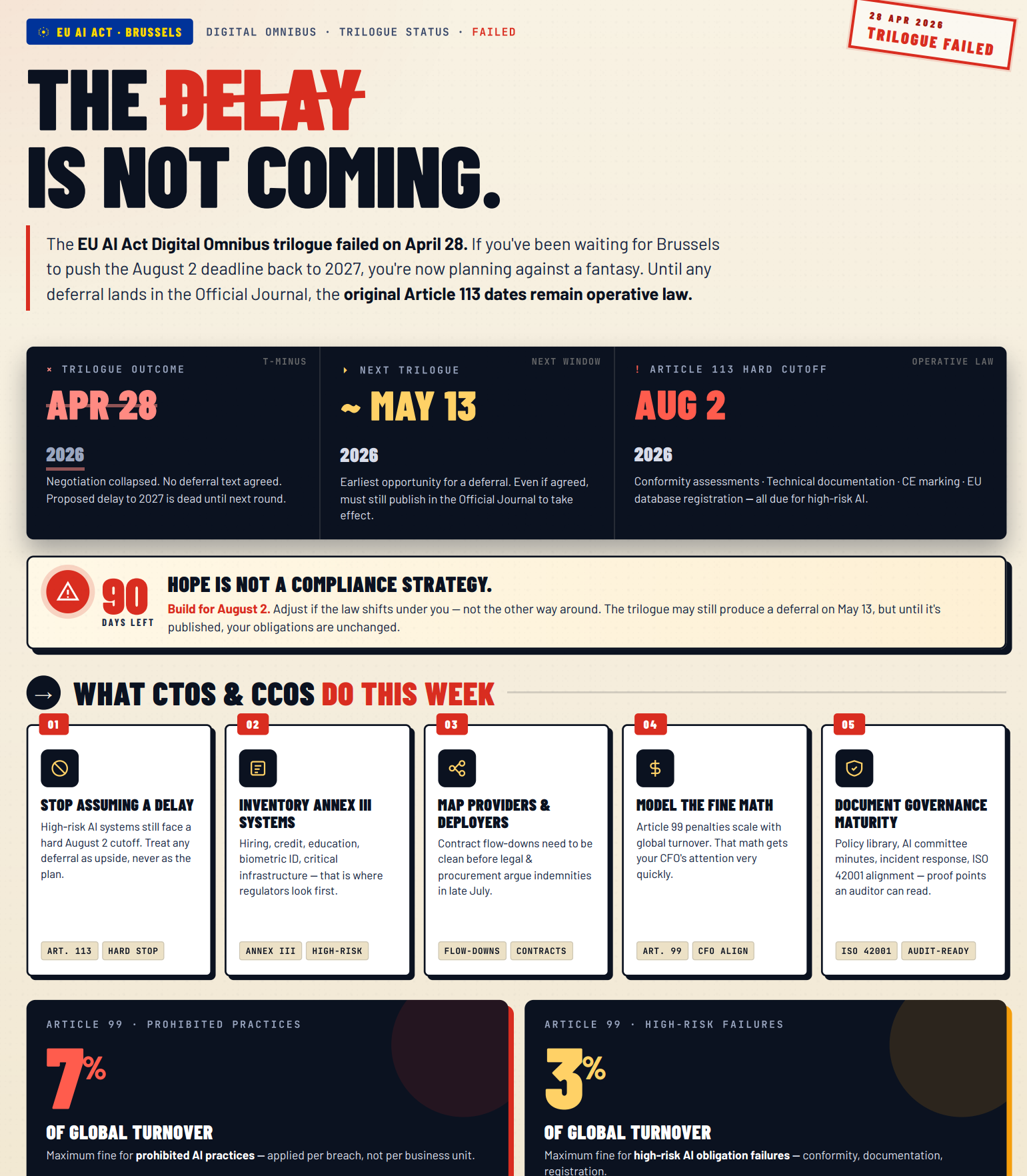
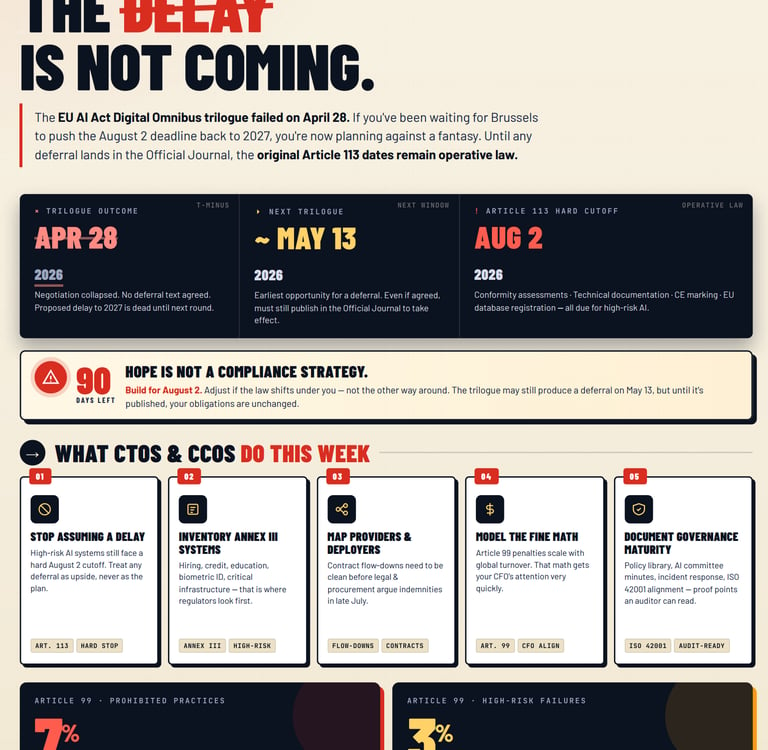
When the second EU AI Act Omnibus trilogue collapsed on April 28 after 12 hours of negotiation, a lot of compliance leaders exhaled in the wrong direction. The instinct in most boardrooms was to assume Brussels would, in some form, push the August 2, 2026 high risk obligations into 2027. That instinct was wrong.
Until any deferral is signed and published in the Official Journal, the original Article 113 timeline of the AI Act stays in force. August 2 remains the operative deadline for high risk system providers and deployers. The next political trilogue is scheduled for around May 13. Even an agreement that day would still need to clear the formal legislative process before any new dates apply.
For CTOs and chief compliance officers running AI portfolios with EU exposure, the next 90 days are not a waiting room. They are the home stretch.
What the Failed Trilogue Actually Disagreed On
The popular narrative is that EU institutions disagreed about whether to delay. They did not. All three institutions had agreed in principle on new dates: standalone Annex III high risk systems would move to December 2, 2027, and AI embedded in regulated products would move to August 2, 2028.
The breakdown was about Annex I architecture. Specifically, when AI is embedded in products already covered by EU sectoral safety law, including medical devices, industrial machinery, in vitro diagnostics, toys, and connected vehicles, should the AI Act layer additional conformity obligations on top of existing rules, or should sectoral law govern alone? Council and Parliament could not align on which agency or assessment body owns the conformity process.
This matters for two reasons. First, it tells you the deferral is still likely to land, just not yet. Second, it tells you that companies who sell into product categories regulated by sectoral law will see the most legal complexity once the new framework arrives.
"Hope is not a compliance strategy. Build for August 2 and adjust if the law shifts under you."
Five Moves to Make in the Next 30 Days
The companies that come out clean on the other side of this regulatory window are doing five things right now.
1. Lock down your AI inventory. Most enterprises do not yet have a single source of truth for every AI system they operate, build, or license. Without that inventory, you cannot risk classify, you cannot track deployer obligations, and you cannot answer a regulator. Start with shadow AI. Lenovo's recent enterprise survey found that roughly 70 percent of corporate AI usage falls outside formal IT control. That is your largest compliance gap.
2. Map every system to Annex III categories. Hiring tools, credit decisioning, education ranking, biometric identification, critical infrastructure, law enforcement support, and democratic process tooling are where regulators will look first. Even a single system in one of these categories triggers full provider or deployer obligations.
3. Run conformity assessment readiness. For high risk systems, you need technical documentation under Article 11, a quality management system under Article 17, and clear post market monitoring. The CE marking process and EU database registration are not optional. If you are using a notified body, the calendar pressure on those bodies in summer 2026 will be intense.
4. Tighten your contract flow downs. Deployers are pushing obligations to providers. Providers are pushing back. Get your contractual language clean before procurement and legal sit in a room arguing in late July.
5. Prepare your governance evidence. Grant Thornton's 2026 survey found that 78 percent of executives are not confident they could pass an independent AI governance audit within 90 days. The fix is not more PowerPoint. It is documented policies, an AI committee with charter and minutes, an incident response plan, a risk register, training records, and ISO 42001 alignment if you can afford the audit cycle.
Why ISO 42001 Is Suddenly the Smart Bet
April brought a wave of ISO 42001 certification announcements: Willkie, K&L Gates, Intetics, ibex, Omny, and others. Two patterns stand out. First, law firms are moving fast because their clients are starting to ask. Second, ISO 42001 is becoming a procurement filter. Customers buying AI services want an independent attestation that you operate an AI management system aligned with recognized risk controls.
For Dynamic Comply clients, ISO 42001 is now the most defensible single move you can make in the next 12 months. It hardens your governance posture, gives sales a clean answer, and aligns directly to the EU AI Act expectations on quality management.
The Bottom Line
The trilogue failure is a gift in disguise. It removes the temptation to wait. The companies that treat August 2 as live will be the ones with cleaner audits, better contracts, faster sales cycles, and lower fine exposure when enforcement finally lands.
If your team is still debating whether the EU AI Act applies to you, you are already behind. The next regulatory inflection is May 13. Use the next two weeks to inventory, classify, and document.
Need help designing your governance program against the August deadline? Talk to Dynamic Comply.
Download Infographic here
#AIGovernance #AICompliance #AIRegulation #ResponsibleAI #CTO #ChiefComplianceOfficer #EUAIAct #EnterpriseRisk #AIRiskManagement #ISO42001
Connect:
(571) 306-0036
© 2026. All rights reserved.


