The White House Just Tried to Rewrite U.S. AI Governance. Here's What CTOs and CCOs Need to Do Right Now.
Blog post description.
4/27/20263 min read
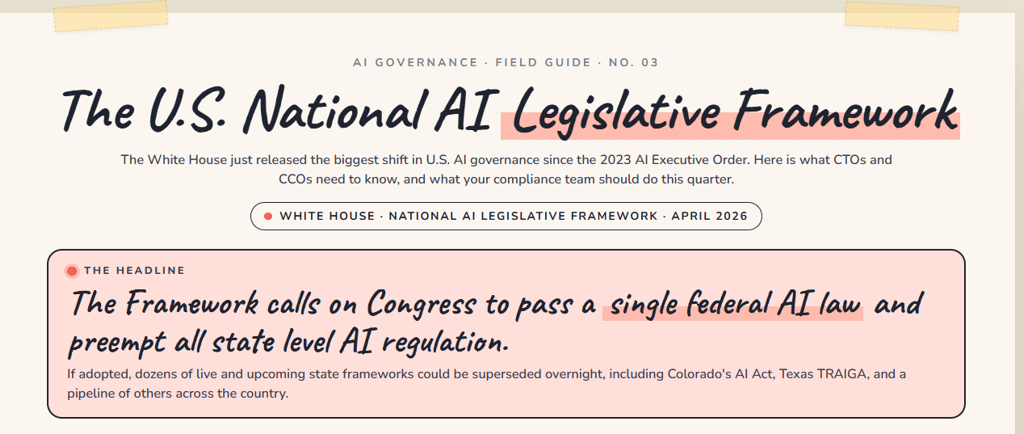
On March 20, 2026, the White House released its National Policy Framework for Artificial Intelligence — a sweeping recommendation for Congress to pass a single federal AI law that would preempt state-level AI regulations across all 50 states. It's the most significant U.S. AI policy signal since the Biden Administration's 2023 Executive Order. And it's already causing compliance teams to ask the wrong question.
That question is: "Should we pause our state AI compliance work?"
The right answer is no. Here's why — and what you should actually be doing instead.
What the Framework Says (and What It Doesn't)
The White House Framework calls on Congress to pass legislation covering seven AI policy categories: liability, copyright, children's safety, national security, deepfakes, transparency, and consumer protection. It explicitly recommends that this federal law preempt conflicting state regulations — effectively nullifying the patchwork of state AI laws that have proliferated over the last two years.
It also pushes back on open-ended liability for AI developers, meaning it's not just a governance story — it's a liability story too.
The Framework is a recommendation from the executive branch to the legislative branch. Congress must act for preemption to occur. That process takes months to years — not weeks.
In the meantime, state laws are active and enforced right now.
The State Law Reality in Q2 2026
Texas TRAIGA went into effect January 1, 2026. It applies to any organization doing business with Texas residents — which includes most U.S. enterprises. Penalties run from $10,000 to $200,000 per violation, enforced by the Texas Attorney General with no private right of action. Critically, NIST AI RMF alignment provides an affirmative defense under TRAIGA.
Colorado's AI Act was delayed from February 1 to June 30, 2026, but it is coming. It requires impact assessments for high-risk AI systems, bias audit documentation, and consumer notification obligations. NIST AI RMF alignment creates a rebuttable presumption of reasonable care under Colorado's law.
The EU AI Act's general application provisions take effect August 2, 2026, with penalties reaching €15 million or 3% of global annual turnover. The EU Council proposed amendments that could delay some high-risk obligations to 2027–2028, but nothing is final, and the August date remains live.
The Three Moves That Matter Right Now
1. Don't bet on preemption timelines. Federal legislation that preempts state law faces significant constitutional and political hurdles. Ropes & Gray published analysis this week questioning the legal limits of the Administration's ability to override state laws via executive action alone. Build for the laws that exist today.
2. Align to NIST AI RMF immediately. NIST AI RMF alignment isn't just best practice — it's active legal protection in Texas and Colorado today. It also maps closely to the EU AI Act's risk-management requirements. It's the closest thing to a universal safe harbor available right now, and it costs you nothing to document.
3. Build an adaptable governance program, not a point-in-time compliance checklist. The organizations that navigate regulatory volatility best are those whose AI governance programs are built on documented risk management, AI inventories, explainability logs, and clear ownership — not on compliance checklists for specific laws. When the regulatory environment shifts, they update their documentation. They don't rebuild from scratch.
The Bottom Line
The White House Framework signals where U.S. AI regulation is heading — toward federal standardization, reduced developer liability, and elimination of the state patchwork. That's a useful directional signal for long-term planning.
But for Q2 2026, your compliance program needs to operate in the world as it exists, not the world as the Administration envisions it. Texas is real. Colorado is real. The EU is real.
The best compliance posture right now is to build a governance program that would survive scrutiny under any of those frameworks — and document that you did so. That's what protects you today and positions you well regardless of what Congress does next.
Download Infograph
Dynamic Comply helps CTOs and CCOs build AI governance programs that work across regulatory environments — today's and tomorrow's. If you're navigating state AI compliance or preparing for EU AI Act deadlines, let's talk.
Connect:
(571) 306-0036
© 2026. All rights reserved.


